Book Review: “The Future We Choose” — A Necessary Read on the Climate Crisis
A book that presents two possible futures for our planet grounded in science — and that, surprisingly, leaves room for hope.
Writing about climate change in a way that keeps people reading is no easy feat.
The subject carries enormous weight, alarming data, dystopian scenarios, a pervasive feeling that the problem is too large for any individual or collective action to make a real difference. Most people who care about the topic oscillate between paralysing urgency and forced optimism.
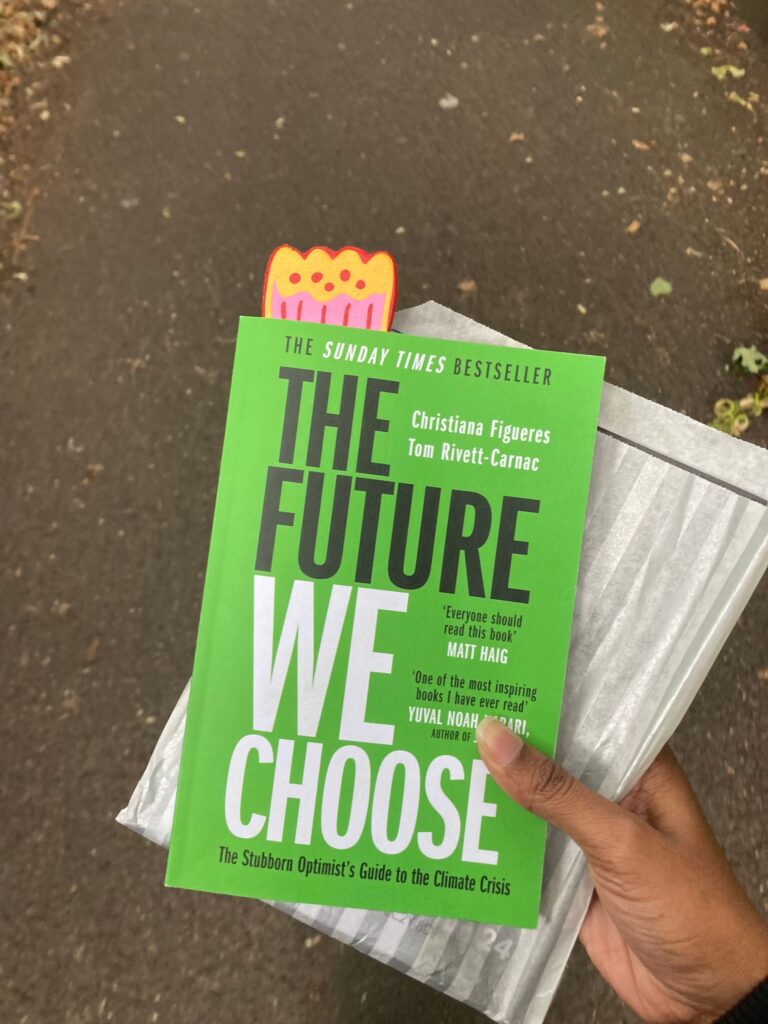
The Future We Choose: Surviving the Climate Crisis, by Christiana Figueres and Tom Rivett-Carnac, is one of the rare exceptions. A book that takes science seriously without becoming inaccessible, and that finds space for hope without being naive.
It remains one of the books that has stayed with me longest after reading it.
The Central Concept: Two Futures
The book’s structure is simple and effective.
The authors present two future scenarios;
- The first: a world in which we fail to control climate change — inhospitable environments, scarce resources, partially uninhabitable cities, a civilisation in survival mode.
- The second: a world in which we thrive — adapting our way of life, reversing some of the damage, building more resilient and sustainable systems.
It sounds like speculation. But it isn’t. Each scenario is built on real scientific data and studies, with full bibliographic references at the end of the book, allowing readers to explore any topic further, extending their reading well beyond the book itself.
What surprised me most was how plausible both futures feel. This is not distant science fiction, these are projections based on choices we are making right now, on policies that exist or don’t, on technologies we are or aren’t deploying at scale.
What Makes This Book Different
There are many books about climate change. Most do one thing well and sacrifice another: either scientifically rigorous and inaccessible, or accessible and superficial. Either so bleak they leave the reader paralysed, or so optimistic they feel disconnected from reality.
The Future We Choose navigates this balance better than any other book I’ve read on the subject. It is:
Clear without being simplistic. The mechanisms of climate change, projected impacts, available solutions, all presented in a way that a reader without a technical background can follow, without a professional in the field feeling talked down to.
Every claim has a scientific basis, and the references are there for anyone who wants to go deeper. But the reading flows, it doesn’t feel like a technical report.
Hopeful without being irresponsible. This was the point that surprised me most. I am, by training and disposition, a pessimist, I work with climate data enough to know how much has already been lost. But the book made me recognise that real progress has happened, that solutions exist and are being implemented, and that the future is not yet written.
Who the Authors Are
The book’s credibility starts with who wrote it.
Christiana Figueres is a Costa Rican diplomat and former Executive Secretary of the United Nations Framework Convention on Climate Change (UNFCCC). She was a central figure in the negotiations of the Paris Agreement in 2015 — considered the most ambitious climate accord ever reached at a global scale.
Tom Rivett-Carnac is a British strategist, co-founder of Global Optimism, an organisation dedicated to addressing the climate crisis, and served as Senior Adviser to the UNFCCC, working closely with Figueres throughout the global climate negotiations.
These are not outside observers commenting on the problem. They are people who were inside the process of trying to solve it, and who chose to write a book not about what went wrong, but about what is still possible.
The Podcast: Outrage + Optimism
For those who finish the book and want to continue the conversation, the authors host the Outrage + Optimism: Climate Change Podcast, which discusses current events and their relationship to climate change, news, policies, technological developments, conversations with other experts.
The title is a good summary of the approach: indignation at what is happening, without abandoning optimism about what is possible. It is the same balance as the book, in audio format and continuously updated.
WhoI Believe This Book Is For
For professionals in the field, architecture, engineering, urban planning, environmental science, etc.
For those outside the technical field, it is an entry point that requires no prior knowledge, and that will likely change the way you read the news on climate.
For pessimists, and I count myself among them, it is a read that does not ask you to abandon realism. Only to look at what has already been done, as well as at what remains to be done.
Highly recommended.